
All Will Be Revealed: A Review of Addie Citchens’ Dominion
Reviewed by Sam stoeltje
As an adolescent confronted with the boring parts of church, say, a phoned-in sermon or a droning major-key hymn, I'd look around for distraction. In that pre-smartphone era, I would have to resort, finally, to the Bible. The book of books. The most reliably entertaining book was of course Revelation, that strange dream of cataclysm and judgment. Much later I would learn that the Revelation of John was, possibly, an elaborate political allegory about Roman oppression, but when I was a kid, it was fire, blood, violence, it was Hollywood thrill and psychedelic freakout and lurid Satanic mythos. It was, potently, all the apocalyptic Christian phantasmagoria that the series of white liberal Protestant congregations my parents tugged me through so proudly and politically refused, in favor of a more humanitarian and mostly hellfree Christianity. Yawn.
The Book of Revelation looms large in Addie Citchens' revelatory, uncompromising Dominion. Revelation is quoted, alongside other scripture, in the programs that open each chapter; it is the origin of the name of the church, the Seven Seals Mission Baptist Church, that is the emotional core of the community that populates Dominion's pages; and it is suggested every time the title of Reverend Winfrey, a main character, is abbreviated ("Rev"). Oh, and near the end, the specter of the antichrist even makes an appearance.
Dominion is a novel of the southern Black church, and of community, family, love and sex, shame and hypocrisy, and ultimately it is also about what, and how, we mean, when we say "evil." The most classic question (How do we know good from evil?) is not answered, not directly, but rather is shown perhaps to be poorly phrased, built upon less than sturdy ground, worth questioning in itself.
One might not expect these concerns—moral, theological, cosmic—from the opening portion of Dominion, which seems smaller in scale. The novel's two focalizing characters, reproduced in alternating first-person chapters, are Priscilla Winfrey, wife of an unfaithful and hypocritical Baptist preacher, and Diamond, who is dating the most accomplished of her sons, Emmanuel "Manny" Winfrey a.k.a. "Wonderboy." Priscilla is a woman on multiple edges, navigating chronic pain and addiction as well as a family riven with, and by, poisonous masculinities. When she stumbles on Diamond and Manny in the act, the status quo of the Winfrey family, or at least their mythic position within the Black community of fictional Dominion, Mississippi, enters an era of what may turn out to be fated fragmentation. Dominion explores the symmetry between Priscilla's and Diamond's relationships to the men that disappoint them, but as the narrative unfolds, the troubled inner life of Manny—star athlete, virtuoso musician, object of fatherly authoritarianism—becomes a central focus.
This is a formally experimental novel. Citchens commits to a heightened polyvocality: distinct first-person point-of-views, but also third-person passages capturing momentous events unwitnessed by Priscilla or Diamond, alongside documents from the world of Seven Seals, namely, programs for church services featuring liturgical questions for the congregation. One of the almost tactile pleasures of this structure is the oscillation between Diamond's lyrical, wonder-struck perception of the sensorium surrounding her—"my mouth was mucky from old sugar," "chatty brown birds blocked our path,"— and Priscilla's cynical resignation: "The house smelled like death had visited, messed everything up, and made a sorry effort at cleaning up behind himself." The programs, authored by Priscilla, are an often funny counterpoint to the dominant narrative of her husband, the Reverend: "How is this scripture reflective of the contagious nature of hypocrisy?" In this space, Priscilla has found an opportunity to resist, and repudiate, at least one form of dominion.
Dominion, that condition of congealed and seemingly perpetual domination, is unsurprisingly a theme. In the Seven Seals Mission Baptist Church, dominion of man over woman, husband over wife, is one foundational problem (among others) that has insinuated itself into the lives of the characters, their relations to each other, and their ability to imagine anything else for themselves. Citchens refrains from preaching, and it is left to the reader to intuit how and why the southern Black church so often reproduces the sex/gender oppression that was one of its inheritances from white colonial Christianity. Rather, she skillfully presents us with evidence of the patterns, their tragic and even monstrous effects.
Monstrosity, too, is in play. Dominion (the condition) yields, if not monsters, then monstrous acts. In its careful exploration of a certain kind of character, what we might call "a bad seed," Dominion participates in but also speaks back to a genealogy of storytelling about the so-called "psychopath." It is an advance upon, even a leveling-up over, other such stories, novels, films, comic books, both in its compassion, as well as in its clarity with regard to the connection between monstrous acts and monstrous systems.
This turns out to be the case particularly in Dominion's exploration of queerphobic self-hatred, itself to be shown as yet another consequence of patriarchal dominion. If Citchens' exquisite polyvocalism suggests Jesmyn Ward, this psychic-social dimension reminds me of insights from Toni Morrison (see "Altruism and the Literary Imagination") and Frantz Fanon (whose theory of sociogeny explored the intergenerational reproduction of certain pathologies). I will note here that "psychopath," like "monster," is a term subject to racialization, often but not only at the hands of a racist criminal punishment system and the dominant iteration of "criminology" that informs it; I do not invoke the "psychopath" lightly, but rather to emphasize how Dominion disrupts the term's normative process of meaning-making, which can cause us to simply stop thinking in the face of "evil."
The Book of Revelation, to some the final word on evil, shows itself as the perfect allusive opportunity for Dominion. Alongside heteropatriarchal domination (e.g., "the whore of Babylon"), not to mention other forms of domination, in Revelation we see revealed a certain bleak adoration of dominion-as-such, dominion in itself. If John the Revelator was hungry for revenge against the pagans, the lingering hangover of that (by some accounts) unchristian hunger is the fetishization of conquest and punishment, the latter-day drive to immanentize the lake of fire, in whatever corner of the planet turns out to be geopolitically convenient. Or whatever bedroom, boardroom, back alley.
The idea of the psychopath is morally convenient: unrepentant souls destined for damnation, to whom we could not realistically owe anything at all, aside from perhaps incarceration, punishment, state-sanctioned murder. Less convenient, more troubling, is the psychopathy of systems, which by their nature not only reward, but reproduce monstrous acts. This is the stuff of "cycles of violence." At the end of The Bad Seed, the film, Rhoda is zapped by a lightning bolt, and a more Biblical, punishment-gratifying ending there could not be. If Dominion can be said to punish its own bad seed, there is no satisfaction in it, only a regarding horror at the persistent functioning of a psychopathic system: though not, perhaps, the one we might expect. All will be revealed.
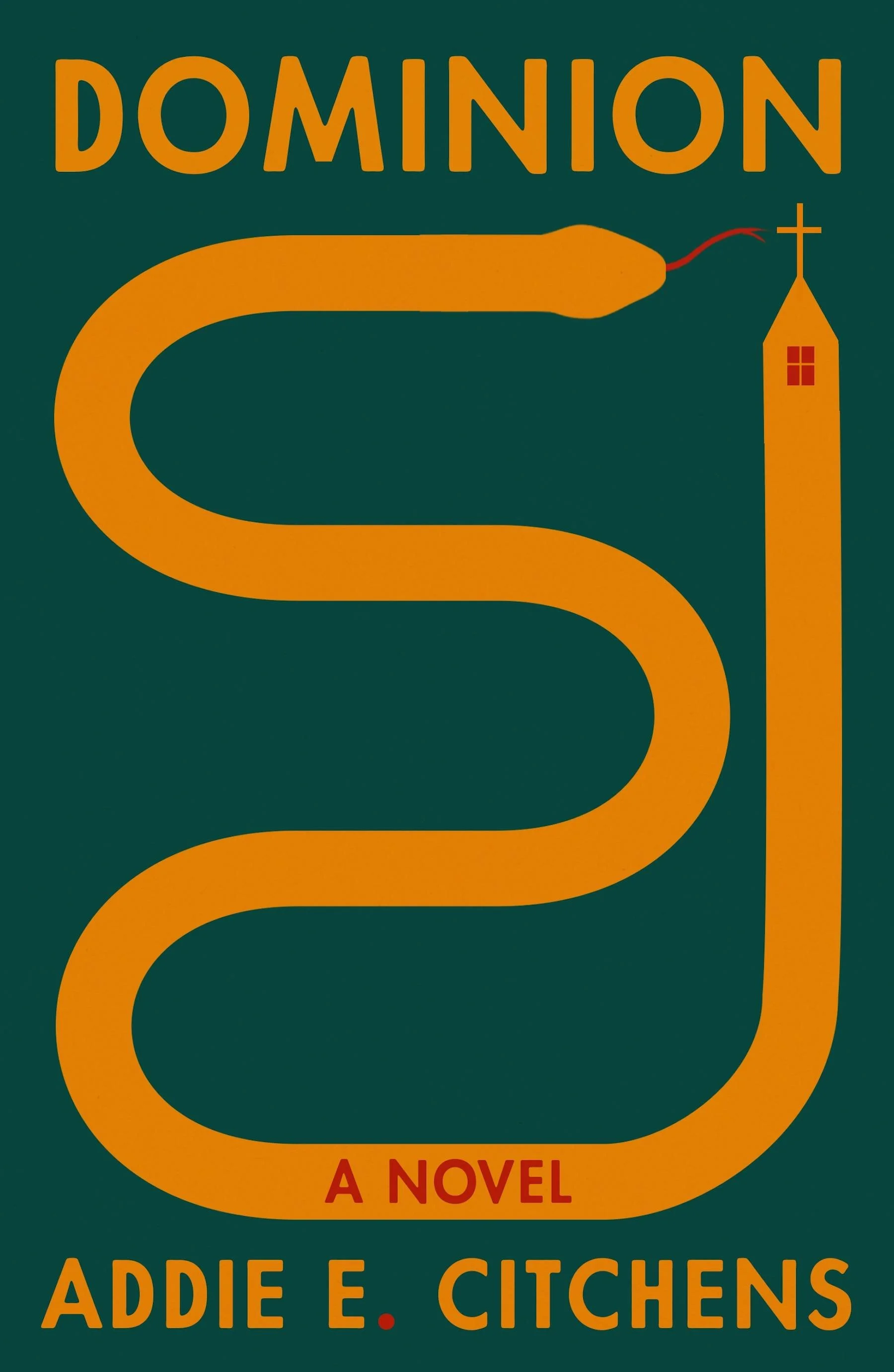
Dominion by addie citchens
—
macmillan - farrar, strauss, and giroux, 2025
—
Fiction / 240 pages / $18

Sam Stoeltje is a writer of fiction that plays with the constraints of genres, namely realism, fabulism, autofiction and theoryfiction. Having earned a doctorate in literature at Rice University, they are also a committed educator in the fields of Indigenous literature, U.S. literature, religious studies and decolonial theory. Their writing has appeared in Plantings, Hypocrite Reader, Magic, Ritual and Witchcraft, and elsewhere. They currently teach for the College in Prison (CiP) program through Herkimer College. A longtime musician, they provide vocals and electronics for turin.mass, an experimental metal project. They are secretly trying to break into YA.