
“You have to help us—but you can’t come any closer”: A Review of Joe Sacksteder’s Hack House
Reviewed by grace morris
The haunted house is a long-standing tradition of horror. It paints over the familiar with fear, leaving us boxed in by terror where home used to be. The haunted house is, as Joe Sacksteder says in Hack House, making use of Freud’s term for the uncanny—unheimlich, or unhomelike. Using this dismantling of shelter, haunted houses explore danger in its disguised forms, like the betrayal of first boyfriends, backbreaking and low-paying labor, or toddlers armed with razors. If home isn’t safe, then it seems nothing is. As the corruption of the historical Hack House infects the characters, everything becomes unhomelike.
Joe Sacksteder’s 2024 novel Hack House opens inside a house already rendered unfamiliar, as the stress of painting and the lower-class painters themselves, make Franco Losada feel displaced in his own home. After a tragic accident with the initial painting crew, the Losada family hires the Lotus Painting Company to complete the repaint of their home, called the Hack House. All six men on the crew are distinct and interesting, but their anxieties and trauma are equally exploitable by the evil of the house. Confusion and miscommunication quickly become dangerous, and the fears haunting the crew and family begin to overtake everyone who comes into close contact with the house.
By utilizing these characters, their class discrepancies, and their work, Sacksteder stays rooted in the contemporary while the typical haunted house narrative is dictated by the past. With an unwavering focus on the sprawl of modern classism, Sacksteder considers how wealth and poverty converse with the guttural horror of the unhomelike.
The gentrification of Ann Arbor is central to the novel, embodied in the luxurious yet maddeningly built Hack House—an innocent mansion for its family and a nightmarish job for the painters. Within the text, the house isn’t described as a whole or a historical beauty to behold. Instead, readers picture the house through the painter’s eye, seeing it in strokes, one truss and soffit at a time. Meanwhile, painting, the intense and unending labor, and the meager pay acts as a disease plaguing the crew until the paint itself becomes toxic. In a particularly notable lapse in a painter’s sanity, Sacksteder writes, “Let it burn. Let it saturate the wood, poison it permanently. Let white blossoms pock the house of some cloistered industrial design fetishist” (303). He fully weaves poison and sickness into the work the painters are faced with.
The novel takes a maximalist approach to the haunted house trope, with a staggering twelve perspectives to follow as they fall victim to the Hack House. Sacksteder whips the reader from scene to scene, eliciting the same disconnect that the characters feel with increasing urgency. It can be difficult to land on your feet each time you’re asked to jump, with some scenes feeling like you’re looking away right when you want to see clearly.
There’s the four members of the Losada family, an upper-class blend of well-meaning snobbery and eccentric neurosis. Franco obsesses over his bees, the oldest son gets his bell rung in a nasty concussion, and the youngest maims the family labradoodle. The mother, by spending so much time away from the house and its contaminants, earns the prize of watching her family slowly come unhinged around her, fumbling to keep up with their death spiral.
Meanwhile, the six person Lotus Painting crew receive the brunt of the house’s waiting fury, falling apart in unique but equally destructive ways. Each character has a distinct perspective, and more importantly, a distinct weakness. Occasionally, a mysterious outsider perspective interjects the narrative, detailing dubiously true historical facts about the house and its con artist first owner. It can be a lot to keep track of. Readers see into these characters’ lives and witness their deepest insecurities as the evil of the house recognizes and begins to exploit them. So, things get ugly. The stressors and conflicts caused by classism and intense work environments are dragged into the light, and it becomes an increasingly difficult task to see the characters past their flaws.
Mundanity skips hand in hand with horror in Hack House. Everyday, easily ignored issues warp into beasts that threaten the lives of ordinary characters, who could be just like us. They could be us. Petty dramas—like a squabble between two crew members over musical talent and jealousy or a first heartbreak for a high school couple—escalate beyond reason until they sour into violence. As the house’s toxins work, no one reacts how they should, and their relationships become unhomelike too. Sacksteder shows off a passion for this project and an impressive catalogue of knowledge, but the extremely detailed scenes can feel as slow as the long days of painting. When chaos does strike, it can be difficult to follow the steps between normalcy and peril, hidden between painter’s talk, and we can be left reeling.
Sacksteder’s Hack House embodies the uncanny, in the most literal translation of Freud’s term unheimlich, in the house that is no longer home. This novel pushes the uncanny to its furthest reaches, sanding its narrative down into slivers for the reader to piece together, revolving through characters quickly to prevent stable attachment to any of them, and only offering a partial resolution when we think the evil is gone. Like the titular Hack House, the book can be unwieldy, disorienting, and clever, but it is most of all unhomelike. In Franco’s words, “Doubt Freud wrote about getting your house painted, but there’s nothing uncannier than an unheimlich Heim” (239). Sacksteder uses the conventions of a haunted house story and the divided setting of Ann Arbor to craft his unique and bewildering novel, twisting the overlooked and ordinary into danger and terror.
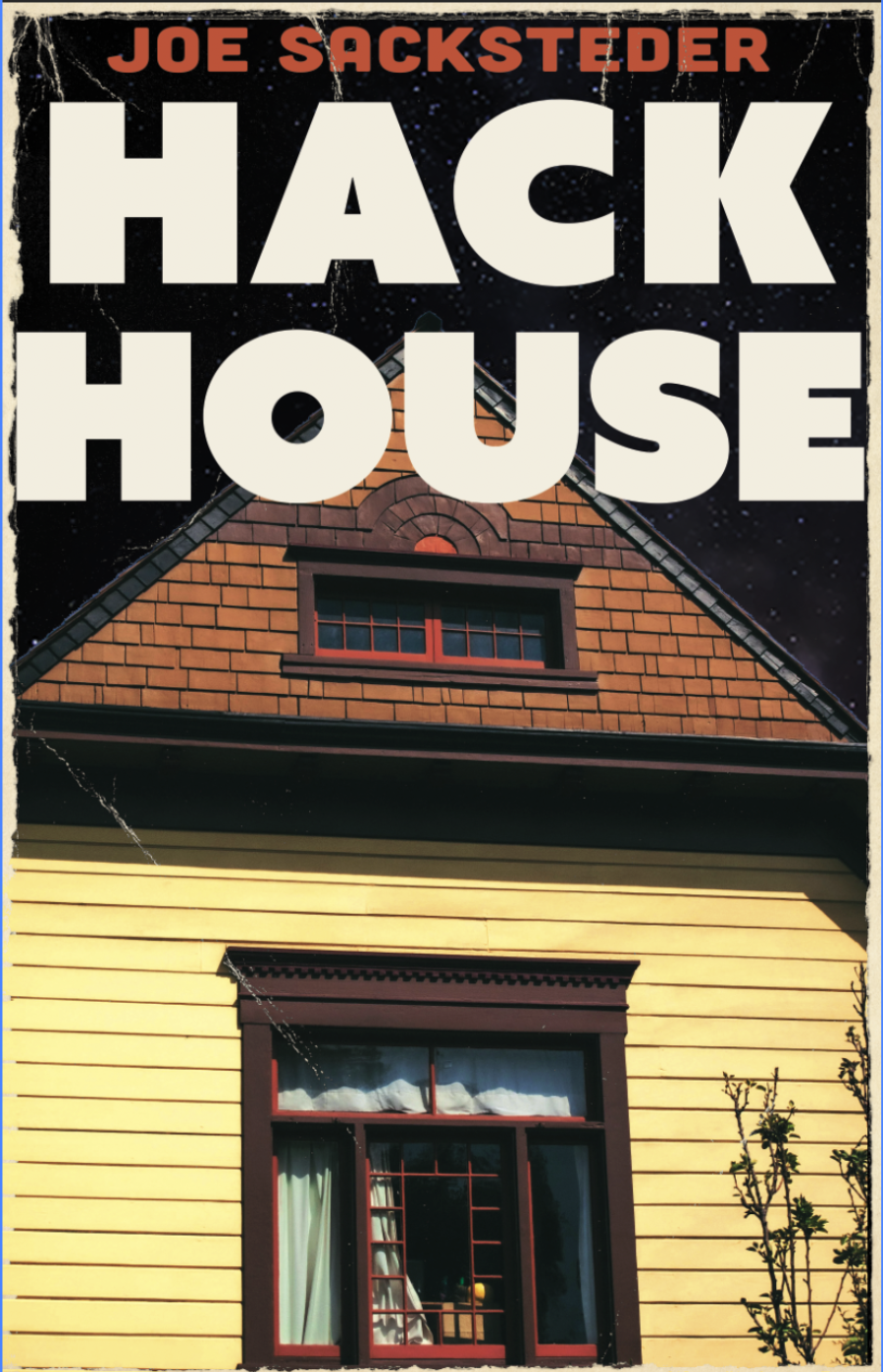
Hack house by joe sacksteder
—
Astrophil press, 2025
—
Fiction / 350 pages / $20.00

Grace Morris is primarily focused on weaving horror into every piece they write, even the love poems. Working in both poetry and fiction, Grace explores queer issues, grief, and trauma through evocative and unique language. Grace graduated cum laude with a degree in English and a minor in Spanish at Metropolitan State University of Denver, and they are currently studying poetry at Syracuse University. Their poetry has been published in two issues of the Metrosphere, and on the Metrosphere website. Grace firmly believes that any subject worth exploring should be explored in a weird and off-putting way.