
Terror-dreaming: A Review of Liz Robbins' Backlit
Reviewed by grace morris
Attitudes towards rape have become so blasé that it frequently is dressed down, spoken of in metaphor and platitude. Rape surrounds us, touches us, but we cannot speak frankly of it. Rape floats around our bodies, never settling to face real consequences, and those who carry this weight are never solid, never given the dignity of being considered real. Rape occupies this unique space between being so common that it becomes boring and being so horrific that it becomes unknowable. Rape is forgotten, or shrunken, or deemed “no longer interesting.”
Liz Robbins in her chapbook Backlit drags rape, survivors, and sex work under bright lights, crafting poems so artful and gripping that we cannot look away any longer. You must look these women, their stories, their pain, in the eye and feel the poems inside you. With clear-eyed narratives, biting diction, and a mastery of placing discomfort in the body of the reader, Robbins highlights the stories of those who are the most abused, discounted, and ignored. In the words of her dedication, her work is “for the powerless.”
The poems in Backlit move quickly and tersely, each line a powerhouse, but the stories are never sacrificed. The mission of each poem is to carve out room for these women, the powerless, to speak of their pain, history, and experience without needing to shrink themselves into toothless generalizations. Robbins uses disgust, scar tissue, and disdain to fuel her writing. What comes across most clearly in Backlit is courage: the courage to tell these stories at all, and the courage to tell them without mincing them into something palatable. A striking example of this is the poem “Dilemmas,” early in the book. Taking place in the ambiguous past of a sex worker, what is made explicit is the abuse the speaker has endured, abuse that she sees reflections of throughout her daily work with the johns. The speaker is reminded of nights at home with her stepdad when a john asks her to choose what position they’ll have sex in. Handling the omnipotence of trauma masterfully, Robbins writes:
“It felt like a quiz I might fail,/ and I’d make salad, he’d take a few bites,/ declare himself not hungry. An hour later, wolfing down/ cereal, surfing porn. Then many beers. Then,/ lurching into my room. But this was proof, wasn’t it, that/ he loved me? That he let me choose?” (10).
Robbins doesn’t shy away from the reality that rape victims are often victims many times over, and that rape is a crime that victims frequently grow into and not out of. There is no age where you are exempt from rape, there is no number of assaults that protects you from more violence. Using mundane, almost childish images and plain language, Robbins puts us in that memory. Loaded terms like porn, beer, and lurching dress the scene in danger.
The narrative of the work has several branches, all with a focused edge that slices the reader. Some poems may refer to one girl, or handful of girls working under the character “Pimp Mike,” but Robbins is able to break away from this story to reveal others who are haunted by this same powerlessness. We travel easily between past and present, throughout different locations, and between stories that contradict each other, but Robbins never loses clarity or intensity. The poem “Family” is told from the perspective of a new and unfamiliar speaker, someone with more power than the other girls in Pimp Mike’s charge. Robbins takes this new relationship and spins it into a harrowing and blunt look at how misogyny and power dynamics can impact sex workers, how they fail to help each other. After detailing the relationships between girls, usually exploitative and full of jealousy, the speaker ends the poem by saying:
“I’ve/ done it all my life, exiling Christy- my sister, myself,- from/ home. And when she comes back that first night, there’s no power like/ mine, her cash limp in my/ hand, and I imagine I can taste the salt on her thighs, her cheeks.” (28)
Using eroticism and careful narrative elements, Robbins takes the lives of the sex workers she’s crafted and complicates them. Sex work isn’t as simple as good and evil, pure and impure. It’s closer to a web. Many strings form one trap, many creatures pull on the strings. When we want to let pity color our reading of the poems, Robbins makes the story more complex, too powerful for a single, flat emotion to cover it.
Robbins doesn’t allow the story to conclude with any false hope, which would dampen the raw experiences into something resembling trauma porn. This was bad, but it’s over now, is too simple of an ending for Backlit. The final poem, “Clean,” lands one final blow and leaves our ears ringing. It’d be easy to exit the book with an understanding of growth or maturity, but we end even more vulnerable than we started. Almost as though the speaker is stuck, or worse,regressing. The final lines of the chapbook read:
“I am very young,/ almost embryonic, the water my father the cloth/ my mother, touching me pristine and in places/ a tender feeling is not so strange.” (39)
We hate to think of it, but rape leaves us vulnerable. It touches us in tender places. It’s a fitting ending for a chapbook that investigates every feeling rape can elicit, even those we don’t want to acknowledge. For survivors, Backlit is a much-needed collection of poems that are unafraid and unapologetic, focusing on the sensations rather than the abstracts of rape which we see discussed so often. This includes, of course, the complexities of rape that are often ignored or encouraged to be forgotten. Robbins is right, ultimately: we wish for a clean mother and father, and a tender feeling that is not so strange.
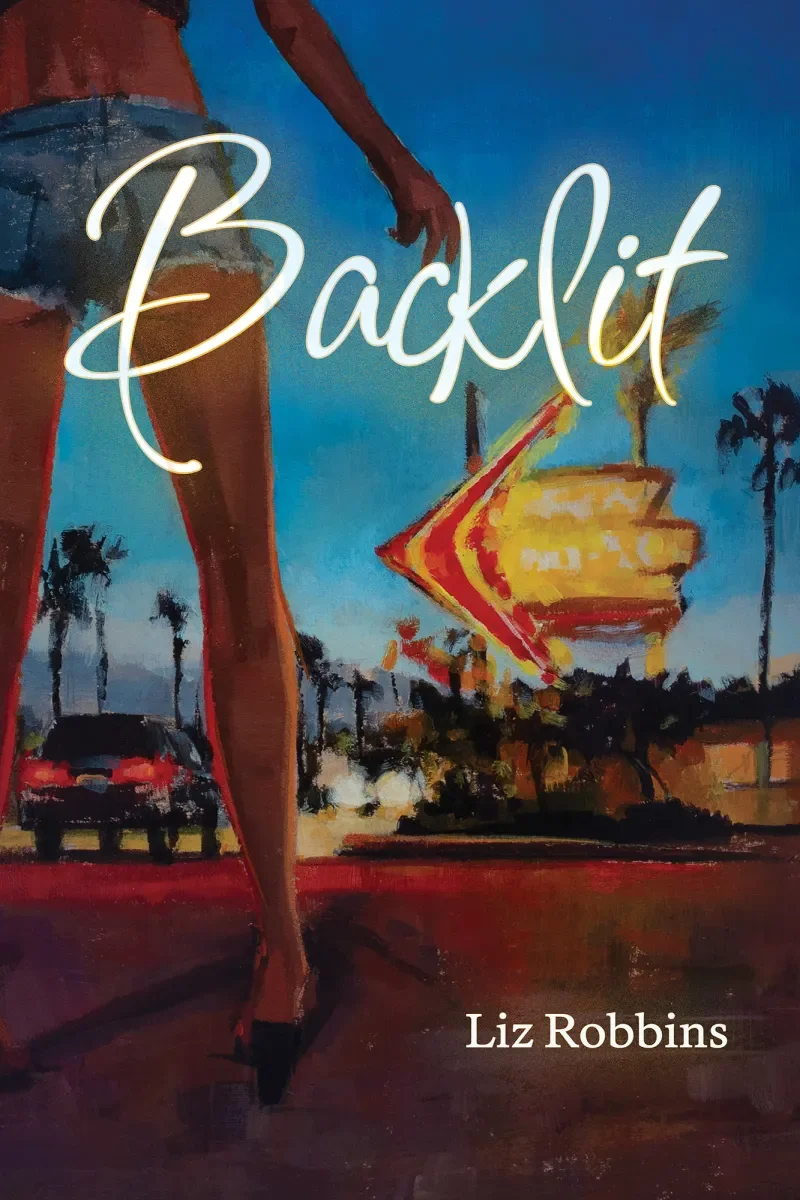
Backlit by Liz Robbins
—
Rattle Foundation, 2026
—
Poetry / 44 pages / $9.00

Grace Morris is primarily focused on weaving horror into every piece they write, even the love poems. Working in both poetry and fiction, Grace explores queer issues, grief, and trauma through evocative and unique language. Grace graduated cum laude with a degree in English and a minor in Spanish at Metropolitan State University of Denver, and they are currently studying poetry at Syracuse University. Their poetry has been published in two issues of the Metrosphere, and on the Metrosphere website. Grace firmly believes that any subject worth exploring should be explored in a weird and off-putting way.